
It is the most common question we get, and the most understandable one. Salt is salt, surely? Not for this.
Reason one: iodine belongs in food, not your sinuses
Nearly all table salt sold in India is iodised, and that is a genuinely good public-health measure — iodine deficiency causes real harm, and fortifying salt is an efficient way to prevent it.
But that reasoning applies to salt you eat. When you dissolve iodised salt in warm water and pass it through your nasal passages twice a day, you are exposing a delicate mucous membrane to something it has no need for. Many people report stinging or irritation as a result.
Reason two: anti-caking agents don't dissolve
Free-flowing table salt stays free-flowing because of additives — typically sodium ferrocyanide, magnesium carbonate or silicon dioxide, depending on the brand. Their job is to stop crystals clumping in humid conditions.
These compounds are not designed to dissolve fully in lukewarm water. Whatever does not dissolve goes into the pot, and from the pot into your nose. It is a small amount, but it is a small amount you are introducing deliberately, every single day.
If the label lists anything beyond salt, it is not a nasal irrigation product.
Reason three: grind size changes the whole rinse
This is the one people underestimate. Coarse crystals dissolve slowly and unevenly. Stir them into 500 ml of lukewarm water, pour immediately, and the first half of your rinse is under-salted while undissolved crystals settle at the bottom of the pot — so the last half is harsher than intended.
An under-salted rinse is precisely what stings. The saline needs to roughly match the salt concentration of your body's own fluids; too dilute and the water pulls into the tissue, which is the burning sensation people describe.
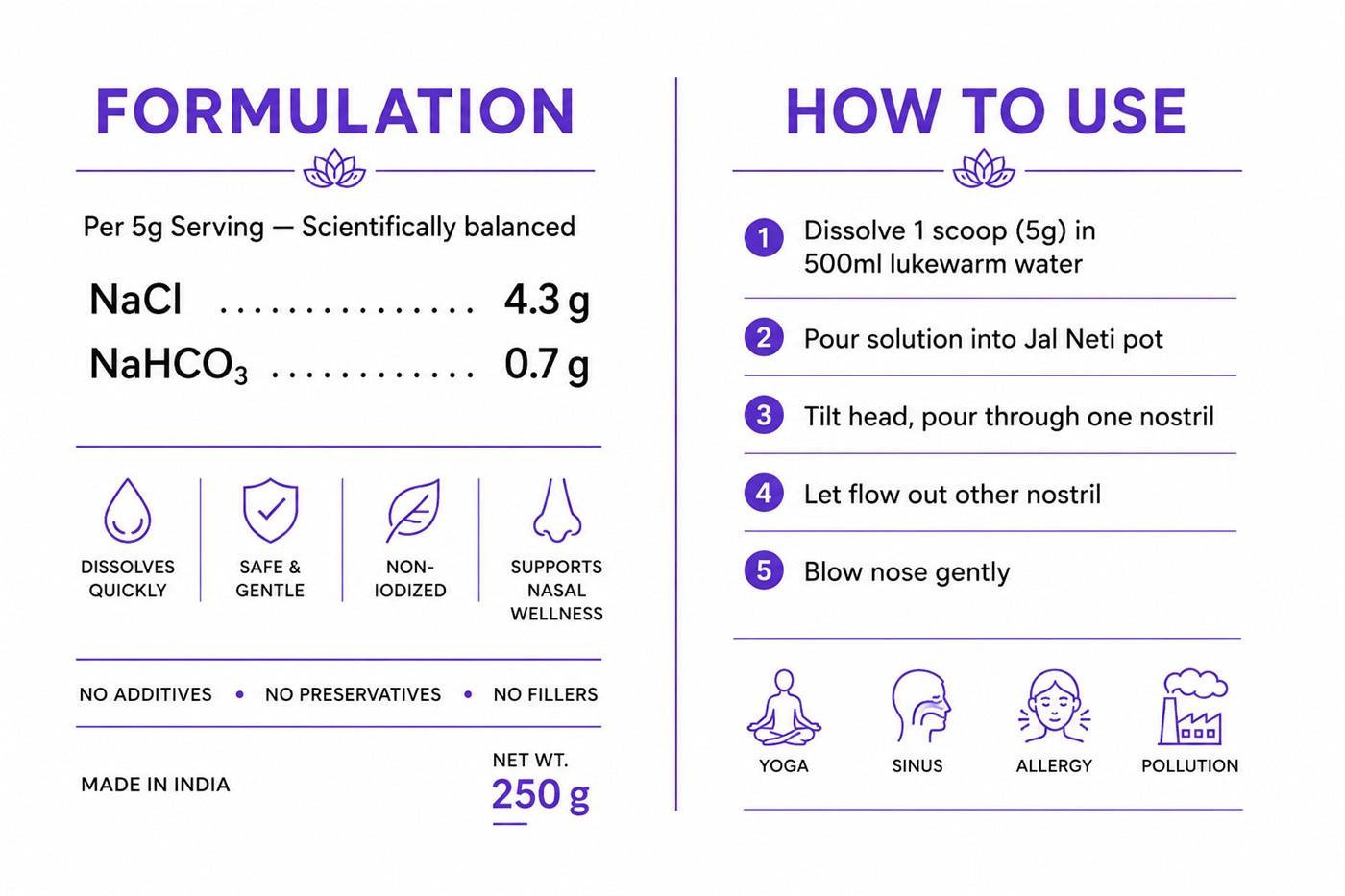
What a purpose-made neti salt looks like
Ankurith Jal Neti Salt contains exactly two things: 4.3 g of sodium chloride and 0.7 g of sodium bicarbonate per 5 g serving.
The sodium bicarbonate is not filler. It buffers the solution, keeping it closer to the natural pH of your nasal lining so the rinse feels soft rather than sharp. It is the difference between a rinse you look forward to and one you endure.
The grind is fine, so it disappears into lukewarm water in seconds. And there is nothing else — no iodine, no anti-caking agents, no fillers, no preservatives, no fragrance.
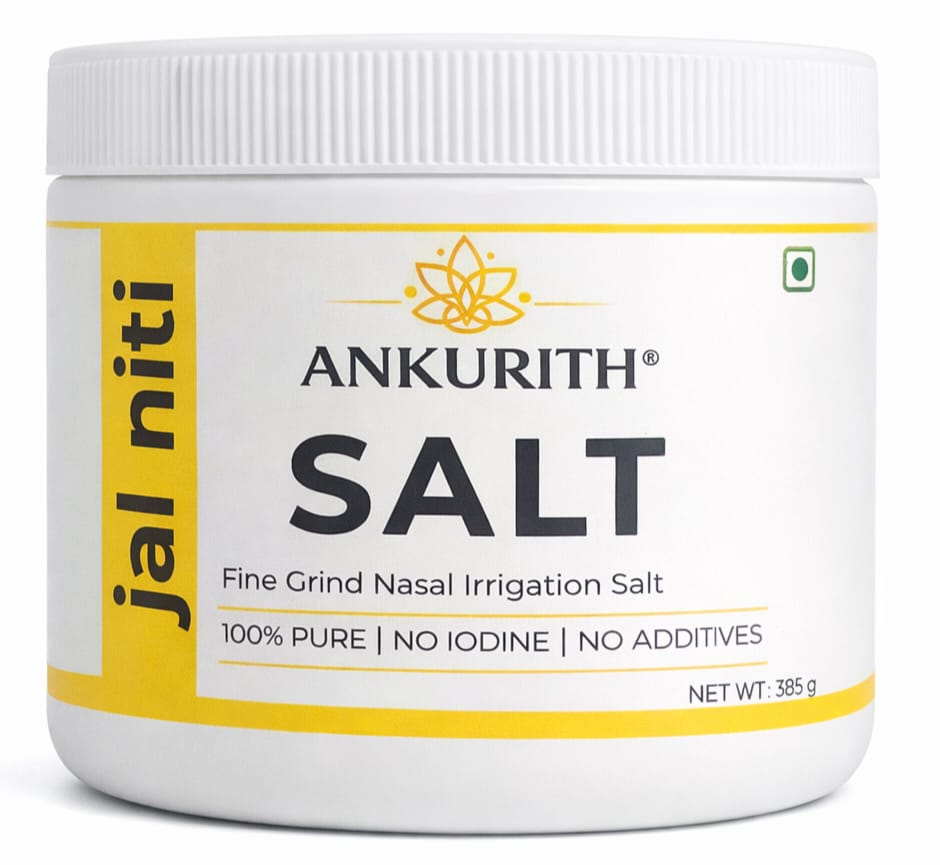
Ankurith Jal Neti Salt
Fine grind, 100% pure, non-iodised. 4.3 g sodium chloride and 0.7 g sodium bicarbonate per 5 g serving, with a measured scoop in every 385 g jar.
Buy on Amazon"Can I use rock salt or sendha namak?"
Better than iodised table salt, but still not ideal. Rock salt is unrefined, which means its mineral content varies between batches and it may carry insoluble grit. You cannot control the concentration reliably, and consistency is the entire point.
If a purpose-made neti salt genuinely is not available to you, non-iodised, additive-free salt dissolved carefully and strained is a reasonable fallback. But measure it, and use the correct water without exception.
Keep reading

Breathing Through an Indian Winter
When the AQI climbs, your nose does more filtering than usual. Here's how to look after it.
Read →
How to Clean Your Neti Pot Properly
A pot that isn't dried properly becomes the very thing you were trying to avoid.
Read →
Building a Five-Minute Morning Ritual
How to fit the practice into a real morning, and make it survive past week two.
Read →