
In short: A nasal rinse should be roughly isotonic — matching the salt concentration of your body's fluids, about 0.9%. Too dilute and osmosis pulls water into the tissue, which stings. Sodium bicarbonate is added to buffer the pH so the solution stays gentle on the nasal lining.
Isotonic, hypotonic, hypertonic
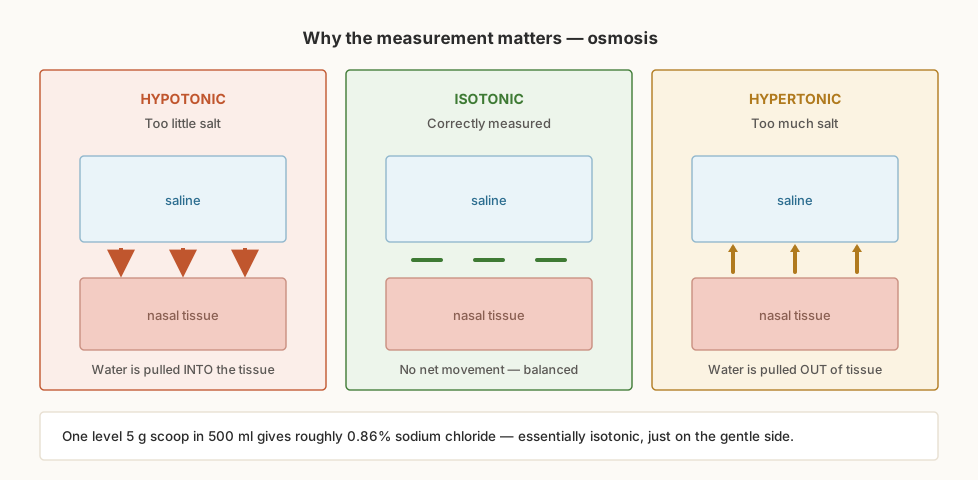
These words sound technical but describe something simple — how the salt concentration of your rinse compares to the fluid in your tissues.
- Hypotonic (too little salt): water moves into the tissue by osmosis. This is the sharp burning sensation people describe. Plain water is the extreme case.
- Isotonic (matched, around 0.9%): no net movement. The rinse feels neutral. This is the target for daily practice.
- Hypertonic (more salt): water is drawn out of the tissue. Some clinicians use hypertonic solutions deliberately for short periods to reduce swelling, but it is more drying and can irritate with sustained use.
This is the entire reason measuring matters. Guessing with a spoon lands you somewhere unpredictable on that scale, and the unpleasant end is the one people usually hit.
Doing the arithmetic
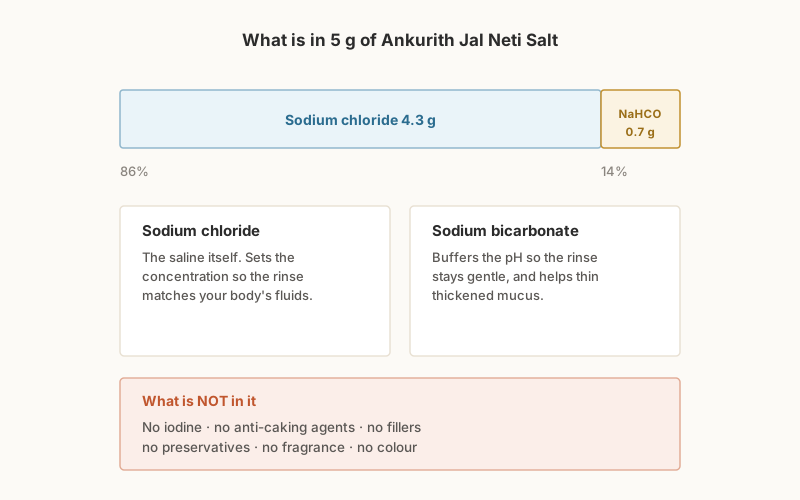
Ankurith's ratio is 5 g of product in 500 ml of water, of which 4.3 g is sodium chloride. That gives roughly 0.86% sodium chloride — essentially isotonic, sitting just on the gentle side.
The remaining 0.7 g is sodium bicarbonate.
Why sodium bicarbonate is in there
Sodium bicarbonate is not filler and it is not there to bulk out the jar. It does two things:
- Buffers pH. It keeps the solution mildly alkaline, closer to the natural pH of healthy nasal mucus, rather than letting it drift acidic. An acidic rinse is noticeably harsher.
- Helps thin mucus. Bicarbonate assists in breaking down thickened, sticky mucus, which is precisely the material you are trying to shift.
A rinse made from salt alone works. A buffered one is simply more comfortable, and comfort is what determines whether you are still practising in a month.
Why not iodised table salt
- Iodine. Table salt in India is iodised by design — a sound public-health measure for a nutrient you eat. There is no reason to irrigate a mucous membrane with it, and many people find it irritating.
- Anti-caking agents. Free-flowing salt contains additives such as sodium ferrocyanide, magnesium carbonate or silicon dioxide to prevent clumping. They are not formulated to dissolve fully in lukewarm water.
- Grind size. Coarse crystals dissolve slowly and unevenly, so the concentration changes during the pour — weak at first, harsh at the end.
What about rock salt or sendha namak?
Better than iodised table salt, but still imperfect. Rock salt is unrefined, so mineral content varies batch to batch and it may carry insoluble grit. You cannot reliably control concentration, and consistency is the entire point of measuring.
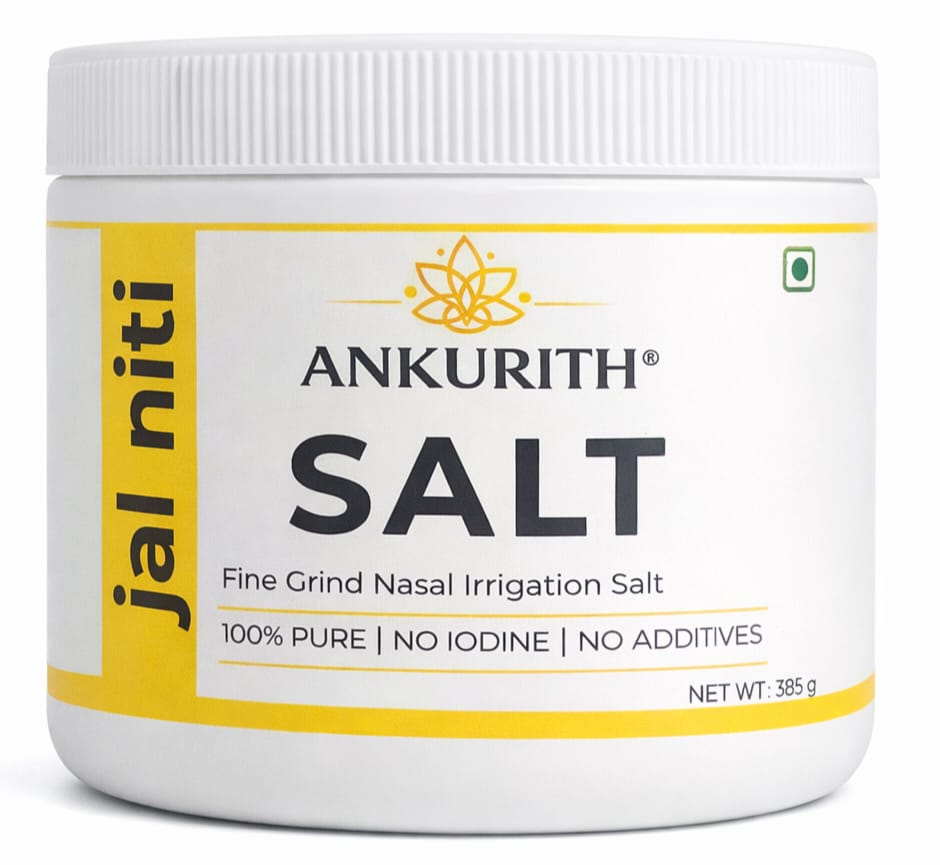
Ankurith Jal Neti Salt
Fine grind, 100% pure, non-iodised. 4.3 g sodium chloride and 0.7 g sodium bicarbonate per 5 g serving.
Buy on AmazonTemperature is part of the formulation
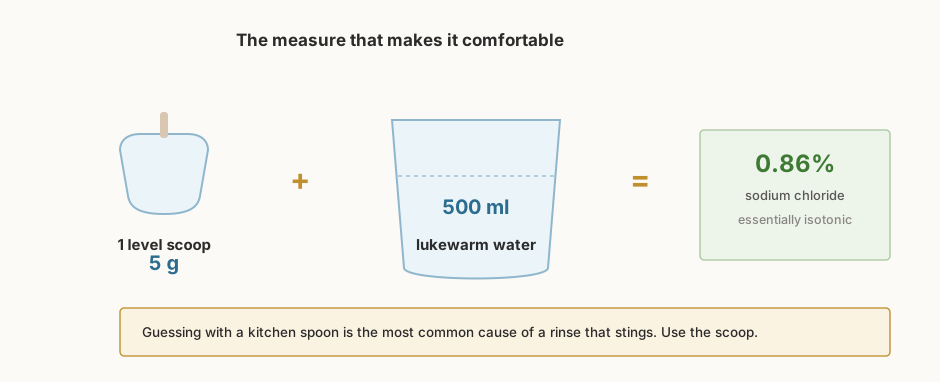
A perfectly mixed solution at the wrong temperature still feels wrong. Aim for lukewarm — close to body temperature. Cold water in the nasal passages is genuinely unpleasant and is the most common reason a first attempt goes badly.
Water safety — the one non-negotiable rule. Use only water that has been boiled and cooled, or that is distilled or sterile. Never use untreated tap water for nasal irrigation. Both the US FDA and CDC issue this guidance because the nasal cavity lacks the stomach acid that neutralises organisms in drinking water. Rare but serious infections, including Naegleria fowleri and Acanthamoeba, have been linked to tap-water nasal rinsing. Full explanation →
Continue learning

What Is Jal Neti?
Definition, etymology, mechanism and scope — the complete foundational explanation.
Read →
Which Water to Use — and Why It Matters
The only genuinely non-negotiable page on this site. What water to use, and the science behind why.
Read →
The Types of Neti
Water, thread, milk and ghee — the traditional variants, and which you should never attempt unsupervised.
Read →